
i remember. . .
Tulsa

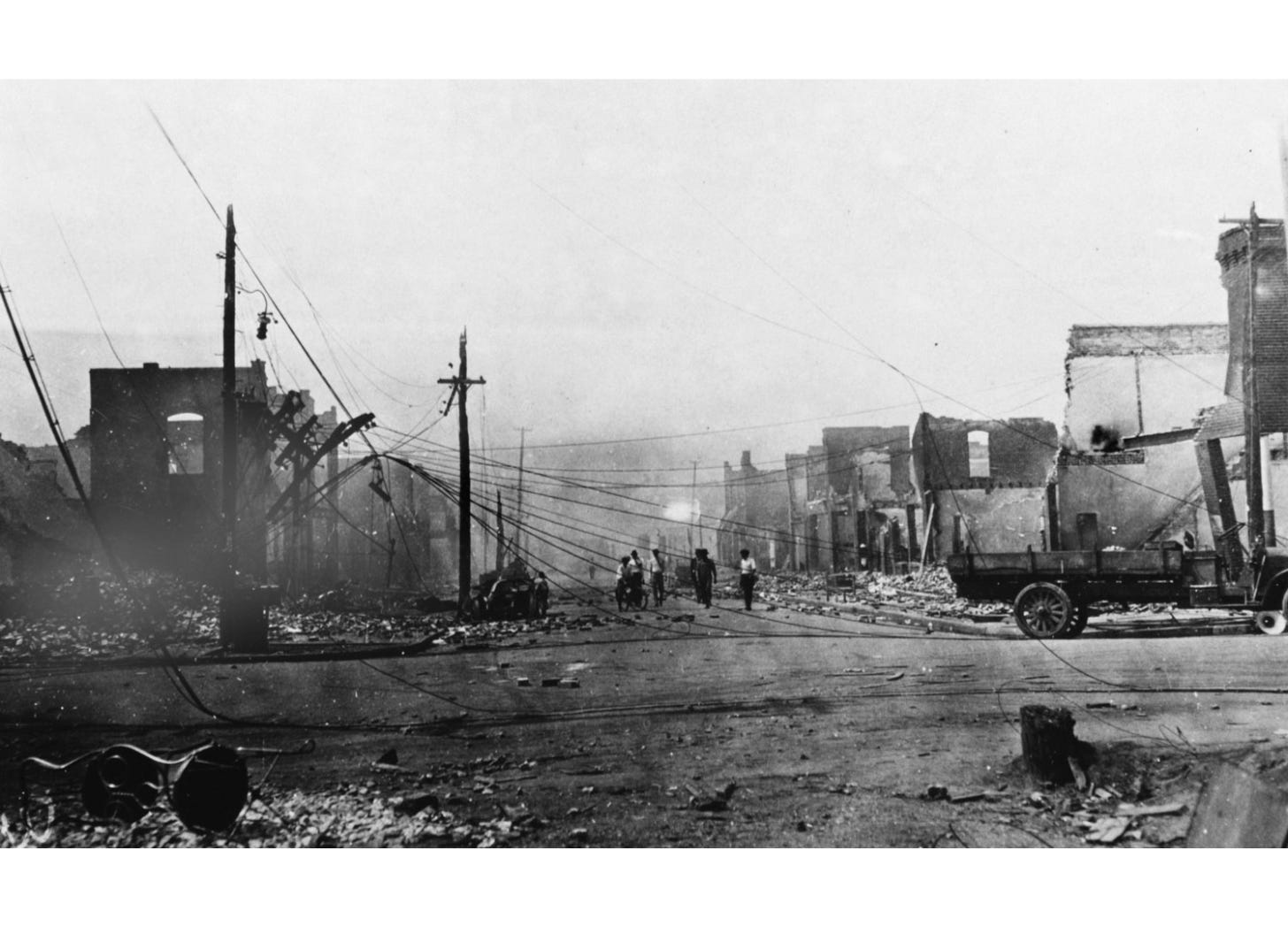
May 31st. A day that will live in infamy.1
Wait! I thought that was December 7, specifically December 7, 1941.
As it turns out, history has more than a few infamous dates.
May 31st is infamous.
Because of what happened.
May 31, 1921.
Tulsa, Oklahoma.
The Ada Weekly News called it a “race riot” in its June 2, 1921 issue.
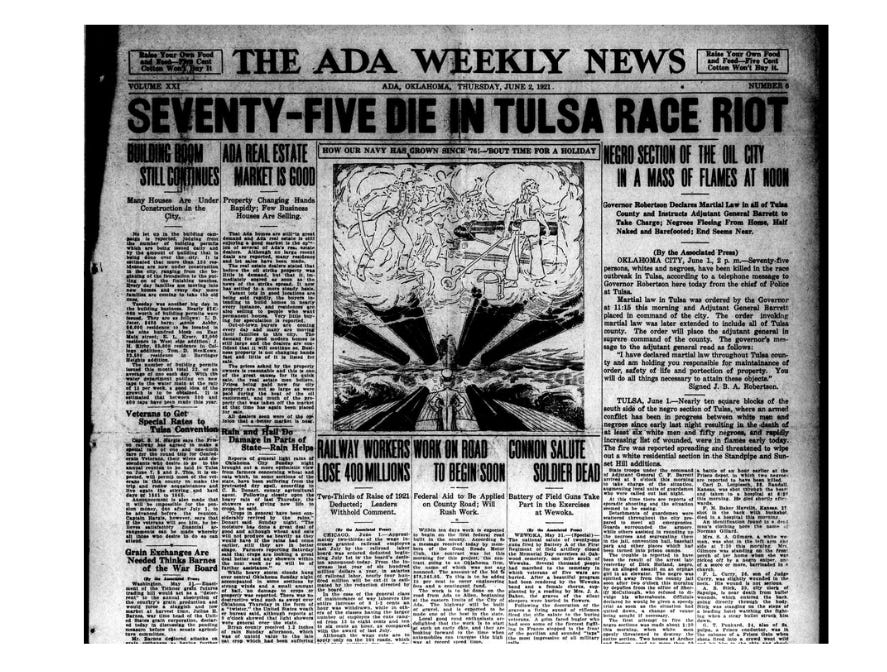
It wasn’t.
It was a massacre.
Here’s the essential story:
It all started the day before, May 30, 1921, when Dick Rowland, a 19-year-old Black man, was accused of assaulting a 21-year-old White woman, Sarah Page. Rowland was arrested and rumors began to spread of his impending lynching. A group of Black men, some armed and several of whom were WWI veterans, went to the courthouse to give protection to Rowland. A larger group of White men showed up, and the Black men retreated to an area of the city called Greenwood.
Greenwood is the area of Tulsa that Booker T. Washington famously called “Negro Wall Street.” It came to be known more popularly as “Black Wall Street.” Many prominent and prosperous black businesses were located there.
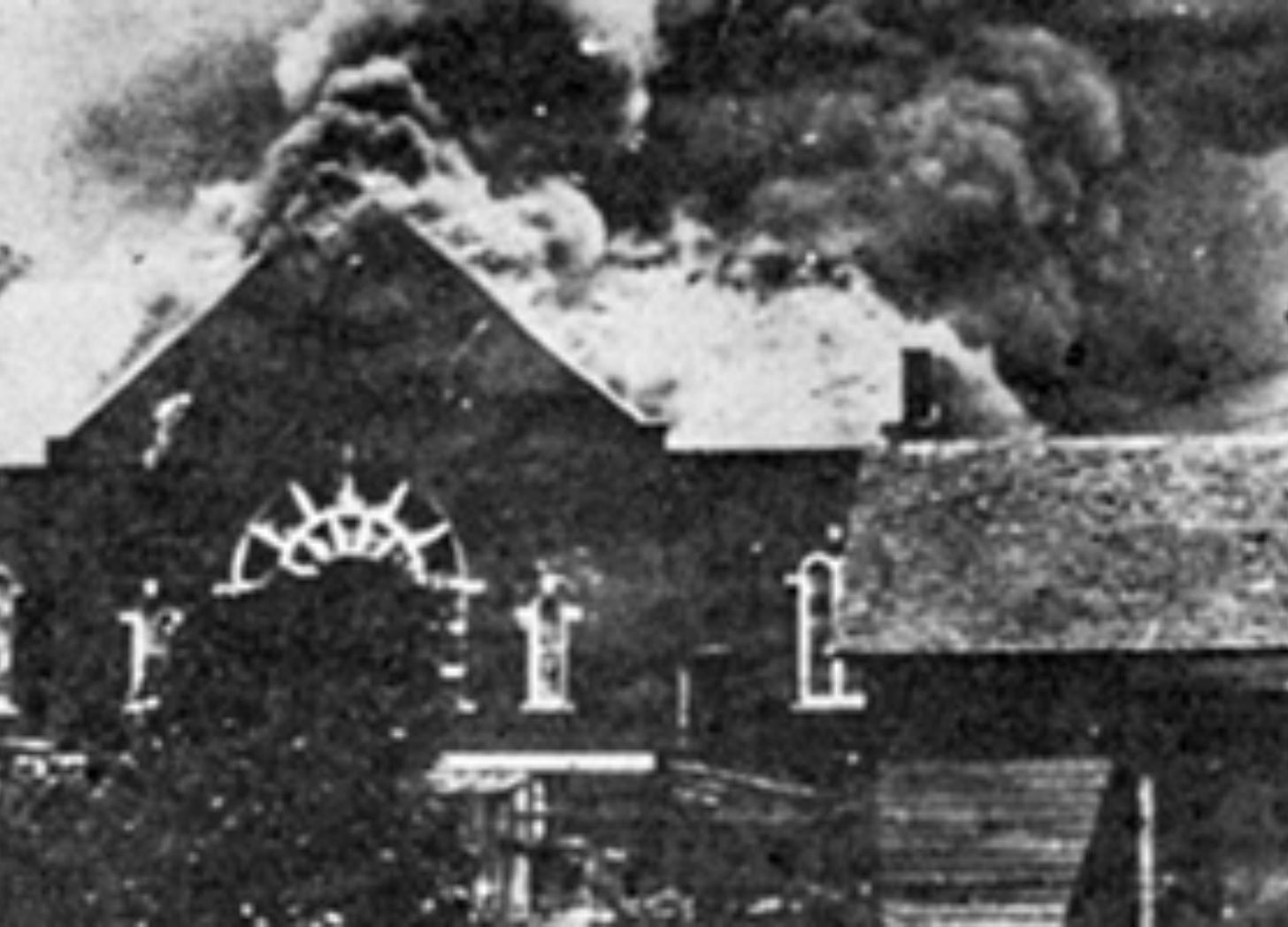
The success of Black Wall Street was the source of much white envy. And, this envy seems to have fueled what happened next. Black Wall Street was attacked and decimated. 1,400 homes and businesses were destroyed. Churches were burned. And, of course, people–current estimates are around 100-300–lost their lives; most of them Black, but some White.
A racial clash in the United States was not new. But, something set the Tulsa Massacre apart. Enraged Whites took to the air in private planes to shoot at Blacks and to drop incendiary devices on Greenwood and its residents.
Who does something like that?!
People do things like that. People motivated by hate, and rage, and envy, and greed, and malice. . . . Rowland was the excuse, but a whole host of cruelties in the human heart were the cause.
While this was happening, Rowland remained in jail. He was not lynched. In fact, he was exonerated because of a letter Page sent to the county attorney in September of that year. All charges were dropped. Upon his release, Rowland fled the area. Details of his life after September 1921 are sketchy, though it appears he spent time in Kansas City and lived out his days in Oregon.
Even though he wasn’t to blame–envy and hatred were–the memory of Tulsa, May 31, 1921, must have been a terrible burden to bear. I wonder how many times he played back the tape of what happened, asking himself what he could have done differently. I wonder if he went to his grave, blaming himself for something that was out of his control.
I hope he found peace. He deserved it.
It’s been 105 years. Why bring it up?
Some would suggest that the wound is healed. Black Wall Street rebounded and was more prosperous in the 1940s than it was in the early 20s. Today, it’s on the National Register of Historic Places, though it’s a mere shadow of its former self since federal and local city planning took their toll in the 1960s and 70s.
So, again–Why bring it up?
In a word, lament.
Life is about lauding accomplishment, sure.
But also about lamenting the awful.
Both require that we remember.
And memory is where lamenting starts.
Now, when I write about lament, I do so with a particular form in mind. It is the five-part form we see in the book of Psalms.2 Although the order can vary, these are the basic components:
Crying out to God
Statement of the distress
Statement of trust in God
Prayer for the matter to be dealt with
Praise to God
When I teach the lament form to new students, I typically use Psalm 22 because of the ease with which we can identify the various components in this lament psalm. Psalms of lament can be individual or corporate in nature, grieving personal failure or even national loss.
This structure tells us something important about the nature of laments. They are in essence expressions of hope and faith. It’s true that they call out the harm, the injustice, and the sin. But they do that because the writers recognize that this is not how things ought to be. Something is wrong with the situation, and I want you, God, to do something about it!
Several years ago, I was part of a research team with 7 colleagues; Abigail, Anthony, Brian, Dave, Jess, Rob, and Tamala. Four were pastors. Four were professors. We were studying the impact of the practice of lament on combating racism. As a part of our work together, we agreed to write our own laments. One of us–I believe it was Rob–wrote something like, “I don’t want you [God] to just hear me; I want you to do something!” That stayed with me. I still feel it.
So, here we are, 105 years later, and today I remember Tulsa.
But in remembering that massacre, I remember other acts of cruelty.
And, I lament them.
I lament that they happened. I lament that they are happening now. And I lament that they will happen in the future.
I lament the destruction of whole communities.
I lament the mass slaughter of children whose only crime was showing up to school.
I lament the loss of one life to a bullet.
The point is that I lament them, in the sense that the psalmists did.

I sorrow. I grieve that they happened. But I do this looking for a day when such acts of terror will be things of the past.
A little later today, I will be at St. Pat’s Anglican Church here in Lexington. We will confess the Nicene Creed, ending with these words, “I look forward to the resurrection of the dead and the life of the world to come. Amen.”
#AsburySeminary #lament #hope #Tulsa #BlackWallStreet
All photos are from the Oklahoma Historical Society. To see more and to read about the massacre, visit this page: https://www.okhistory.org/learn/tulsaracemassacre
In all but one psalm, Psalm 88, there is some kind of upward expression of trust in God and prayer for His intervention. Psalm 89 fills that purpose, which suggests that the two should be read together.
Thanks for writing this! There is much from a human to human standpoint to lament. Yet, I also lament the ecocide of our natural world. But, like you I say with hope, “I look forward to the resurrection of the dead and the life of the world to come. Amen.”